Australian
Natural Adventures
Wildlife,
Nature & Soft Adventure Tours
Custom
Australia, New Zealand & Pacific tours and travel

THE
NATURAL HISTORY & WILDLIFE OF AUSTRALIA

18
Days
This inclusive
study tour covers Eastern Australia from the Great Barrier Reef and
rainforests of tropical North Queensland to the mountains and plains
of Victoria. Along the way participants will see many kinds of kangaroos,
the unique platypus, koalas, rare marsupials, over 200 species of
birds including parrots, bowerbirds, kookaburras and emus, and reptiles.
A single reef on the Great Barrier Reef can have more species of fish
and coral than the entire Caribbean, and a full day is devoted to
this World Heritage Area. Two other World Heritage Areas - the Wet
Tropics and Croajingolong National Park - are included in the itinerary.
We spend two days in Sydney, with its Opera House, Bridge and beaches.
Itinerary
Day
1 - Los Angeles / Lost in Space
Check in at the Tom
Bradley International Terminal at Los
Angeles Airport for your Qantas flight 176 departing at 11.55pm
to Brisbane, Australia. Australia begins the moment you step aboard
your Qantas
flight. The Australian style is apparent—easy going, casually
efficient and very friendly. Qantas is known for its excellent food
and in flight service, so sit back and enjoy the hospitality, meal
and a movie. (*D)
Day
2 – Lost in Space
Day lost due to the International Dateline, but regained on the return
journey.
Day
3 – Brisbane / Cairns
A arrive or Brisbane, Australia at 7.55am this morning. After pass
through customs and immigration transfer to Qantas flight 69 to Cairns,
far North Queensland, leaving at 10.05am. On arrival in Cairns at
12.20pm we are met by our guide for the next few days. After loading
our gear onto the luggage trailer of our small bus we head south and
west  to
the Atherton Tablelands. We first travel through sugar cane fields,
the main agricultural product of the region, then turn inland to climb
onto the Tablelands, a rough plateau averaging 3000ft in altitude.
Once extensively covered by rainforests, it has been partially cleared
for crops and cattle, but much of the forest and its wildlife remain.
A significant portion of this remaining forest is part of the federally
protected Wet Tropics World Heritage Area, notable for rare and restricted
wildlife and plants. Considered to contain the
to
the Atherton Tablelands. We first travel through sugar cane fields,
the main agricultural product of the region, then turn inland to climb
onto the Tablelands, a rough plateau averaging 3000ft in altitude.
Once extensively covered by rainforests, it has been partially cleared
for crops and cattle, but much of the forest and its wildlife remain.
A significant portion of this remaining forest is part of the federally
protected Wet Tropics World Heritage Area, notable for rare and restricted
wildlife and plants. Considered to contain the 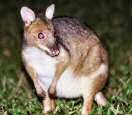 most
significant occurrence of primitive flowering plants in the world,
these rainforests give scientists the ability to step back to the
origins of all flowering plants. These rainforests contain the highest
concentration of rare and restricted species in Australia, and the
greatest diversity of mammals. Our accommodation for the next two
nights is The Chambers, a lodge set in the rainforest, and visited
by a wide range of birds and mammals, right at our door. Dinner tonight
is a barbecue at the lodge, and we are sure to be visited by pademelons,
a small rainforest wallaby, and other locals.
(*B,*L,D)
most
significant occurrence of primitive flowering plants in the world,
these rainforests give scientists the ability to step back to the
origins of all flowering plants. These rainforests contain the highest
concentration of rare and restricted species in Australia, and the
greatest diversity of mammals. Our accommodation for the next two
nights is The Chambers, a lodge set in the rainforest, and visited
by a wide range of birds and mammals, right at our door. Dinner tonight
is a barbecue at the lodge, and we are sure to be visited by pademelons,
a small rainforest wallaby, and other locals.
(*B,*L,D)
Day
4 – Atherton Tablelands
Today we explore the Tablelands; our precise itinerary is determined
by the weather and our guide’s experience of current wildlife
occurrences. We visit Lake Barrine, formed in the cone of an extinct
volcano, and home to eels, turtles and rare fish. We often see pythons
as long as 14 ft basking on the side of the lake, and waterbirds around
the edge. Walks in the area’s rainforest may reveal Musky Rat-kangaroos,
the smallest and most primitive of the kangaroo family. Either early
this morning, this afternoon or tomorrow morning we’ll spend
time at a rainforest stream, waiting for views of p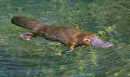 latypus
in the wild. This egg-laying mammals was thought to be a hoax when
first introduced to the scientific community. After dinner tonight
we go spotlighting at higher altitude to find some of the mammals
– most are nocturnal in Australia – including the black
and white Herbert River Ringtail Possum, Green Possum, Coppery Brushtail
and perhaps tree kangaroos, a true kangaroo which has taken to life
in the tree. Reptiles such as the 8 inch long and bizarrely shaped
Leaf-tailed Gecko may also be found, along with owls, frogs and even
pythons.
(B,D,)
latypus
in the wild. This egg-laying mammals was thought to be a hoax when
first introduced to the scientific community. After dinner tonight
we go spotlighting at higher altitude to find some of the mammals
– most are nocturnal in Australia – including the black
and white Herbert River Ringtail Possum, Green Possum, Coppery Brushtail
and perhaps tree kangaroos, a true kangaroo which has taken to life
in the tree. Reptiles such as the 8 inch long and bizarrely shaped
Leaf-tailed Gecko may also be found, along with owls, frogs and even
pythons.
(B,D,)
Day
5 – Atherton Tablelands / Kuranda / Cairns
We finish our stay on the Tablelands, then head into much drier  country
at Granite Gorge. Here we look for Rock Wallabies among the huge boulders,
and may see the Great Bowerbird at its bower, complete with trinkets
to impress potential mates. We have lunch (own expense) while looking
around the country town of Mareeba - an opportunty to eat like a typical
Aussie and to get some insight into the life of rural Australians.
At nearby Kuranda we take the Skyrail down to the coast, a 1 hour
cable-car journey through and across the top of the rainforest, giving
sweeping views across Trinity Inlet to the Coral Sea, close-up looks
at giant staghorn ferns in the treetops, and waterfalls below. At
end of this journey we transfer to our accommodation near the Cairns
waterfront. The evening is free to look around this interesting small
tropical city, or perhaps visit the Esplanade for some shore-birding.
(B)
country
at Granite Gorge. Here we look for Rock Wallabies among the huge boulders,
and may see the Great Bowerbird at its bower, complete with trinkets
to impress potential mates. We have lunch (own expense) while looking
around the country town of Mareeba - an opportunty to eat like a typical
Aussie and to get some insight into the life of rural Australians.
At nearby Kuranda we take the Skyrail down to the coast, a 1 hour
cable-car journey through and across the top of the rainforest, giving
sweeping views across Trinity Inlet to the Coral Sea, close-up looks
at giant staghorn ferns in the treetops, and waterfalls below. At
end of this journey we transfer to our accommodation near the Cairns
waterfront. The evening is free to look around this interesting small
tropical city, or perhaps visit the Esplanade for some shore-birding.
(B)
Day
6– Great Barrier Reef
Today you are introduced to one of the natural wonders of the world—Australia’s
Great Barrier Reef, a series of reefs extending for about 1,250 miles
along the coast of Queensland, nearly to Papua New Guinea. Our destination
today is the outer edge of the reef, where the coral formations present
a barrier to the open sea. We anchor in the calm water immediately
inside this edge for our first experience of this world marvel. As
soon as we look underwater we see brilliantly
colored fish, giant clams, and coral outcrops. Easy swimming in
shallow water brings us over coral “bombies,” heads of
coral with their assortment of fishes, and hard and soft corals. Parrot
fish glean algae from the coral, and small and medium predators search
for food. Schools of fish twist and flash between the outcrops. An
occasional sea turtle may be seen. Lunch is a tropical smorgasbord
on board. The diversity is amazing; there are more species of fish,
invertebrates and coral on a single reef of the Great Barrier Reef
than in all the Caribbean. Both snorkelers and certified divers are
catered for (divers will need to bring their cards), and new or inexperienced
snorkelers will be show the ropes by the experienced staff. We move
to several locations for variety, and may see several species of seabirds
during our day. We return to Cairns late afternoon, and the evening
is free to look around this small tropical city. (L)
Day
7 – T Cairns / Alice Springs
The first part of the morning is free for a final walk along the Esplanade,
a swim in the pool or a quick shop before we return to the airport
for our 11.45am Qantas flight 1949 to the center of Australia, Alice
Springs, arriving at about 1.55pm. We are met and begin our exploration
of this small city and surrounds, the heart of the Red Centre. Originally
established as a telegraph station to serve the line running from
Adelaide to Darwin to Asia, and hence to Europe, The Alice, as the
town is referred to, has grown into a comfortable small city. The
surrounding McDonnell Ranges and desert, and the clear and brilliant
blue skies, provide a stunning setting. The Todd River runs through
the city, but like most rivers west of the Great Dividing Range, it
is dry most of the time. However, this doesn’t stop the locals
from arranging boat races – they simply knock the bottoms out,
and run the course holding their craft. As it is quite hot at this
time of the year, our time spent outdoors is mostly late afternoon,
and tomorrow morning. (B,*L),
Day
8 - Alice Springs / Uluru (Ayers Rock)
A very early start this morning to take advantage of the wildlife
activity and the cool part of the day, as we head east of Alice Springs
through the majestic East MacDonnell Ranges. After crossing the dry
bed of the Ross River, we stop under the shade of as giant river red
gum to contemplate the ancient landscape and have breakfast. Our morning
will continue with short walks into some of the East MacDonnell Ranges
most picturesque gorges, providing viewing of Aboriginal rock art
and carvings. Later another short walk into Trephina Gorge provides
spectacular views of this very special place that will live long in
your memory of our visit to Central Australia. We return to Alice
Springs in time for our short lunchtime flight (Qantas 1941 at 12.30pm)
south to Ayer’s Rock, now mostly know by its Aboriginal name
of Uluru. We arrive at 1.25pm, and check into our accommodation. We
have some time to freshen up before heading off to Uluru itself. One
of the most famous sights in Australia is the mystical vision of Uluru
changing from red to purple to black as the sun sets in the outback.
From our vantage point we watch this transformation, an event that
has occurred unchanged for millions of years, watched by us today
just as 40,000 years ago the ancestors of the Pitjantjatjara &
Anangu people did. Most amazingly, these people are still living here
today, in an unbroken chain, as we shall see. (B)
Day
9 - Uluru
Awake early this morning – before sunrise – to visit Uluru
itself, witnessing the spectacular sunrise without rushing. Short
walks enable us to view rock art, waterholes and some of the unique
flora and fauna of Uluru. Our guides introduce the geology of Uluru
and describe how plants and wildlife have adapted and survived in
such a forbidding environment. They also describe deep the relationship
of the Anangu people to Uluru. This place was shelter, provided water
and is a tangible link with their creation ancestors. As we walk at
the base we hear and see the creation time stories of these ancient
people unfold, and see where the people lived and carried out ceremonies.
Here the beliefs of the local people are embodied in one of the great
places of this world. From a distance Uluru is spectacular; from close
up it is powerful and deeply moving, and presents its exquisite and
dramatic sculpturing. After our time at the base of Uluru we visit
the nearby Aboriginal-operated Uluru-Kata Tjuta Cultural Centre, to
continue our understanding of Uluru and its people. We then return
to the hotel in time for lunch (own expense). B
Late this afternoon
we see another aspect of this red desert. Not as well known outside
Australia as Ayers Rock, but also fascinating, is Kata Tjuta (the
Olgas). These rounded tors are hewn from the same subterranean mass
as Uluru itself, and present their own stories and mysteries. At Olga
Gorge our guide describes the geology of the area and how it has evolved
over millions of years. As we walk through Olga Gorge we learn how
the Aboriginal people used the plants of the area in their daily life.
As the sun sets the domes change color, just like the larger Uluru
– same say the event is equal to Uluru’s own sunset show.
Regardless, the clefts and shadows, and our special perspective, make
this a unique event.
(B)
Day
10 - Sunday, Janaury 15: Uluru / Sydney
The first part of the morning is free for a final look at this desert
landscape. There are short walks to platforms in the nearby dunes
where a longer perspective on the sunrise on Uluru can be had, and
desert birds and lizards may be active. Also a short walk away is
another cultural center, with a good range of souvenirs. Or the opportunity
may be taken for a lie-in after several early morning. At lunchtime
we fly east to Sydney, arriving late afternoon. After transferring,
via a short city sights tour, to our downtown hotel we have to for
an initial look at this famous harborside city. (L)
The
Tour continues >>>>